Planning a healthcare conference in Saudi Arabia requires a clear understanding of event licensing. The Saudi Conventions and Exhibitions General Authority (SCEGA) regulates conferences, exhibitions, and seminars across the Kingdom. For healthcare and medical events, a SCEGA permit is often necessary, and additional approvals from authorities such as the Ministry of Health or the Saudi Food and Drug Authority may apply depending on the event’s content. This guide covers the 2026 requirements, official application steps, fees, and the practical planning considerations every organizer should know.
What Is a SCEGA Permit?
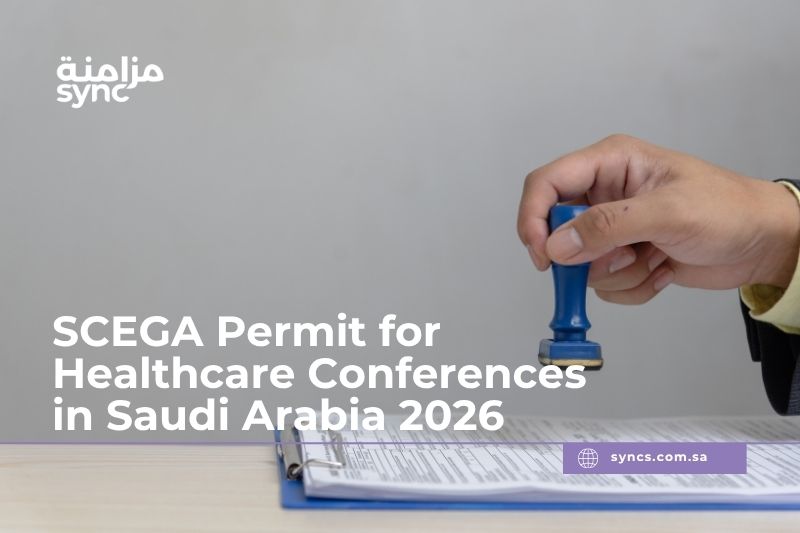
A SCEGA permit is an official license or approval issued by the Saudi Conventions and Exhibitions General Authority that authorises an event to be held in Saudi Arabia. SCEGA’s remit covers conferences, exhibitions, forums, seminars, and workshops, regardless of sector. The permit confirms that the event meets national organisational standards and is listed in the official event calendar.
It is important to distinguish between a SCEGA event permit and sector-specific approvals. SCEGA licensing covers the event as a commercial or professional gathering. It does not automatically replace approvals required by healthcare regulators for scientific content, continuing medical education (CME) accreditation, pharmaceutical exhibitions, or the involvement of medical devices.
Do Healthcare Conferences in Saudi Arabia Need a SCEGA Permit?
Most healthcare conferences held in Saudi Arabia require a SCEGA permit or licence. The exact requirement depends on the event’s classification local conference, international conference, seminar, or forum and whether it is open to the public, by invitation only, or includes an exhibition component.
Events organised by government entities or certain academic institutions may follow a different approval path, but the majority of standalone healthcare conferences organised by associations, professional societies, PCOs, or corporate bodies will fall under SCEGA’s licensing scope. International conferences, particularly those with foreign speakers or exhibitors, almost always require a SCEGA permit. Because healthcare events often involve scientific programmes, pharmaceutical sponsors, and CME accreditation, organisers must also evaluate additional regulatory requirements alongside the SCEGA application.
SCEGA Requirements for Healthcare Conferences in 2026
When preparing a SCEGA application for a healthcare conference, organisers should be ready to provide:
- Organiser information : Commercial registration (CR) or legal entity details of the organising body.
- Event title and type : Clearly defined conference, seminar, or forum.
- Event dates and duration : Start and end dates, including setup and dismantling days for any exhibition.
- Venue details : Confirmed venue with a booking agreement or letter of intent.
- Expected attendance : Estimated number of participants, including healthcare professionals, speakers, and sponsors.
- Programme / agenda : A draft scientific programme or conference agenda. This is typically required to verify the nature of the content.
- Supporting approvals (if applicable) : Evidence of coordination with relevant healthcare authorities or confirmation that applications are in progress.
- Speaker and exhibitor information : In some cases, a list of international speakers or exhibiting companies may be requested.
Requirements can vary based on the event classification. Organisers should always check the latest list of mandatory fields on the official SCEGA e-services portal before preparing the application.
Documents Required for a SCEGA Conference Permit
The table below summarises the documentation typically required when applying for a healthcare conference permit through SCEGA. Items marked event-dependent are not requested for every application but may be required for certain event types or when specific activities are planned.
| Requirement / Document | Status | Purpose |
|---|---|---|
| Organiser commercial registration | Required | Establishes the legal entity responsible for the event |
| Event title, type, and description | Required | Defines the event for classification and approval |
| Venue booking confirmation | Required | Confirms the physical location and dates |
| Conference programme / agenda | Typically required | Demonstrates the content and professional nature of the event |
| Speaker and presenter information | Event-dependent | May be needed for international conferences or CME accreditation |
| Exhibitor and sponsor details | Event-dependent | Required when an exhibition or commercial sponsorship is part of the event |
| Proof of healthcare authority coordination | Event-dependent | May be requested if the programme involves medical education, pharmaceuticals, or devices |
Organisers should not submit incomplete applications. SCEGA may pause processing until all required documents are uploaded.
How to Apply for a SCEGA Conference Permit
The application process is completed online through SCEGA’s official e-services platform. While the exact interface may be updated, the general steps for a healthcare conference permit are:
- Log in to the SCEGA e-portal (scega.gov.sa) using the organiser’s account or create a new one if this is the first event.
- Select the relevant service : Usually “Event Licensing” or “Conference Permit,” choosing the appropriate event category.
- Define the event classification : Specify whether the event is a local conference, international conference, seminar, or other.
- Complete the application form with all required event details, dates, venue, and organiser information.
- Upload supporting documents : Attach the venue confirmation, programme, commercial registration, and any healthcare-related approvals that are already available.
- Pay the applicable fees through the portal.
- Submit the application and note the reference number.
- Respond to any additional information requests from SCEGA during the review.
- Receive the permit : Once approved, the event licence is issued and should be kept for record and on-site compliance.
SYNC’s recommended event-planning practice: Start compiling documents and finalising the scientific programme early. Aligning the SCEGA application timeline with venue booking and speaker confirmation avoids last-minute delays. When additional healthcare approvals are required, SYNC integrates those milestones into the master conference timeline so the SCEGA submission is supported by a complete regulatory picture.
How Much Does a SCEGA Permit Cost in 2026?
SCEGA publishes an official fee schedule on its e-services portal. Fees are categorised by event type, duration, and sometimes by the profile of the organiser. As of the latest available information, conference licensing fees vary depending on whether the event is local or international, and whether an accompanying exhibition is included.
No additional unofficial fees should be paid outside the SCEGA portal. For complex healthcare conferences with a large exhibition, the total licensing cost may be calculated based on the combined elements verify during the application.
Do Healthcare Conferences Need Additional Approvals in Saudi Arabia?
SCEGA approval addresses event licensing, but healthcare conferences frequently require additional clearances. The relevance of each depends on the event’s scientific content, target audience, sponsors, and activities.
- Ministry of Health (MOH) : May need to approve or be notified of conferences involving healthcare practitioners if the event includes CME/CPD accreditation or public health messaging.
- Saudi Commission for Health Specialties (SCFHS) : If the conference offers CME hours, SCFHS accreditation is mandatory. This is separate from SCEGA.
- Saudi Food and Drug Authority (SFDA) : Required when pharmaceutical products, medical devices, or samples are displayed, distributed, or discussed in a commercial context during an exhibition.
- Healthcare professional associations : May have their own endorsement or content review requirements, especially for scientific sessions.
- Sponsor and exhibitor compliance : Pharmaceutical and device companies must follow SFDA promotional regulations, which may affect booth design and material distribution.
Not every healthcare conference needs all these approvals. A purely academic symposium with no exhibition and no CME credits may only need SCEGA clearance, whereas a large international congress with an exhibition, sponsored symposia, and CME accreditation will need SCEGA plus a combination of MOH, SCFHS, and SFDA clearances. Organisers should map regulatory requirements at the earliest planning stage.
Can You Promote a Healthcare Conference Before Receiving SCEGA Approval?
SCEGA regulations generally prohibit public promotion, ticket sales, or registration before the event permit is issued. Organisers may send preliminary “save the date” communications to a closed, professional audience, provided no registration is opened and no commercial promotion takes place.
Public marketing campaigns, sponsorship announcements, paid advertising, and social media promotion should only begin after the SCEGA permit is granted. For healthcare conferences that also require CME accreditation or SFDA clearance, promotional activities should also respect those authorities’ rules. Launching full marketing before regulatory sign-off risks compliance issues and could delay or jeopardise the permit.
How Early Should You Apply for a SCEGA Permit?
Official processing time: SCEGA’s e-services platform provides estimated processing times that can range from a few business days to several weeks, depending on event complexity and application completeness. There is no published fixed SLA for all event types; organisers should check the current indication on the portal at the time of submission.
Recommended planning timeline: SYNC advises healthcare conference organisers to start the regulatory planning process at least 3 to 4 months before the event date. This window allows time to:
- Finalise the scientific programme and speaker line-up.
- Confirm the venue and obtain the booking agreement.
- Prepare and submit the SCEGA application with complete documents.
- Initiate healthcare authority applications (SCFHS, SFDA, MOH).
- Receive all approvals before launching attendee marketing.
A compressed timeline is possible for smaller events, but larger international conferences should allocate more lead time. Treat regulatory planning as an integral part of the event timeline, not an administrative afterthought.
Healthcare Conference Planning Timeline
| Stage | Recommended Planning Point | Key Action |
|---|---|---|
| Event concept | Early planning | Define event type, audience, and scientific scope |
| Regulatory mapping | Early planning | Identify all applicable authorities (SCEGA, SCFHS, SFDA, MOH) |
| Venue confirmation | Early planning | Secure venue and obtain booking documentation |
| SCEGA application submission | Before any promotion | Submit complete application with supporting documents |
| Healthcare approvals | In parallel with SCEGA or as required | Submit for CME accreditation, SFDA clearances, etc. |
| Marketing launch | After required approvals | Activate website, registration, and campaigns |
| Registration open | Once regulatory clearance is confirmed | Allow attendees to register |
| Event execution | Final phase | Deliver the conference, manage on-site compliance |
These planning windows are practical recommendations, not government deadlines. Organisers should always check the latest official processing guidance at the time of their event.
SCEGA Permit Mistakes for Healthcare Conference Organizers
- Applying under the wrong event classification : Submitting a conference as a seminar or vice versa can cause delays.
- Submitting incomplete information : Missing venue confirmation or an incomplete programme stalls processing.
- Using inconsistent dates or venue details : Mismatched information between documents and the application form triggers queries.
- Ignoring additional healthcare approvals : Assuming SCEGA covers all regulatory needs can lead to last-minute roadblocks.
- Starting promotion before approval : Marketing a conference without a SCEGA permit is a compliance risk.
- Relying on outdated fee information : Always check the current SCEGA schedule for 2026.
- Waiting too long to start regulatory planning : Late applications leave no room to address requests for further information.
- Treating licensing as a standalone task : Compliance should be integrated with venue booking, speaker management, and production timelines.
How Event Management Partners Help With Regulatory Planning
An experienced event management partner supports healthcare organisations by turning regulatory requirements into a coordinated plan. This includes:
- Defining the event classification and identifying the applicable SCEGA service.
- Building a complete regulatory checklist covering SCEGA, SCFHS, SFDA, and MOH needs.
- Aligning the venue and production planning with regulatory milestones.
- Preparing documentation packages that meet submission standards.
- Coordinating stakeholders scientific committees, sponsors, and authorities to keep timelines on track.
- Integrating compliance into registration, event technology, and on-site operations so nothing is overlooked.
For healthcare organisations planning conferences in Saudi Arabia, regulatory planning works best when it is integrated into the wider event strategy, production, registration, technology, and on-site execution. SYNC supports organisations across these event management functions, helping connect regulatory planning with the practical requirements of delivering the conference. From conference management and smart event technology to full-scale government event production, SYNC’s team brings together the compliance and creative elements that make a healthcare event both compliant and impactful.
SCEGA Healthcare Conference Permit Checklist
Event Definition
□ Define the event type (local/international conference, seminar, forum)
□ Define event objectives and target audience
□ Confirm the organising entity and legal status
□ Confirm event dates, duration, and venue
□ Estimate attendance numbers
Regulatory Planning
□ Identify the applicable SCEGA licensing service
□ Check the latest SCEGA requirements on the official portal
□ Check healthcare-sector requirements (SCFHS, MOH, SFDA)
□ Identify any additional approvals needed for speakers, content, or exhibition
□ Prepare all supporting documents
Before Promotion
□ Confirm SCEGA permit has been received
□ Confirm applicable CME accreditation is in progress or granted
□ Confirm SFDA clearance if pharmaceutical/device exhibition is planned
□ Confirm sponsor and exhibitor compliance measures
□ Finalise venue and operational contracts
Event Delivery
□ Registration platform ready and compliant
□ Guest management and badge system prepared
□ Event technology and AV production tested
□ On-site operations team briefed on compliance requirements
Frequently Asked Questions
Does a healthcare conference in Saudi Arabia need a SCEGA permit?
Most healthcare conferences require a SCEGA permit, particularly if they are international or include an exhibition. The exact requirement depends on the event classification and organiser profile.
How do I apply for a SCEGA conference permit?
Applications are submitted online through SCEGA’s e-services portal. Organisers fill in event details, upload documents such as the venue confirmation and programme, and pay the required fees.
How much does a SCEGA permit cost in 2026?
Fees vary by event type and are published on the official SCEGA portal. Organisers should verify the latest 2026 fee schedule directly on the platform before budgeting.
How long does SCEGA approval take?
Processing time depends on the event and application completeness. Organisers should check the current estimated timeframe on SCEGA’s portal and plan with sufficient lead time.
Can international organisations apply for a SCEGA permit?
Yes, international organisations can apply, often through a local partner or professional conference organiser that holds a valid Saudi commercial registration. The SCEGA application process is accessible online.
Can I advertise a healthcare conference before receiving SCEGA approval?
Public promotion and registration should only start after the SCEGA permit is granted. Closed “save the date” notices to a professional audience may be permissible, but full marketing must wait.
Does SCEGA approval replace Ministry of Health requirements?
No. SCEGA licensing covers the event permit; healthcare-specific approvals from the Ministry of Health, SCFHS, or SFDA are separate and may be required based on the conference programme and activities.
Do medical conferences require additional approvals?
Many medical conferences need CME accreditation from SCFHS and, when pharmaceutical or device exhibitors are present, clearance from SFDA. These are in addition to the SCEGA event permit.
What documents are required for a SCEGA conference permit?
Typically, the organiser’s commercial registration, venue booking confirmation, event details, programme/agenda, and sometimes speaker or exhibitor information. Check the SCEGA portal for the current mandatory list.
Decision Framework
Are you planning a conference in Saudi Arabia?
↓
Is it a healthcare / medical event?
↓
Determine the event classification (local/international conference, seminar, forum)
↓
Check the applicable SCEGA service on the official portal
↓
Identify healthcare-sector approvals that may apply (SCFHS, SFDA, MOH)
↓
Prepare all required documents
↓
Submit the SCEGA application with complete information and fees
↓
Complete any additional healthcare applications
↓
Receive all necessary clearances before opening registration and promotion
↓
Execute the event with full compliance
This framework illustrates the typical planning and approval sequence for a healthcare conference. It is an explanatory guide, not an official government process flow.