
Planning a trade exhibition, product showcase, or consumer exhibition in Saudi Arabia? Understanding the correct exhibition licensing requirements is one of the first steps toward organizing a compliant business event.
The Saudi Conventions and Exhibitions General Authority (SCEGA) regulates qualifying exhibitions and business events in the Kingdom. Organizers must identify the appropriate license category, confirm their eligibility, prepare supporting documents, and follow the applicable approval process.
A SCEGA exhibition license is the official authorization required for exhibition activities falling under the authority’s jurisdiction in Saudi Arabia. License categories include trade exhibitions, product showcases, consumer goods exhibitions, and charity exhibitions. Fees, eligibility, and documentation differ by category. Applications are handled through the official SCEGA electronic portal.
This guide explains the licensing categories, application requirements, government fees, responsibilities, and practical considerations for exhibition organizers in Riyadh, Jeddah, and across Saudi Arabia.
What Is a SCEGA Exhibition License?
A SCEGA exhibition license is an authorization issued by the Saudi Conventions and Exhibitions General Authority for an exhibition that falls within its regulatory scope.
The license relates to a specific exhibition and its approved details, including the organizer, event format, venue, and dates.
It is important to distinguish between:
- Exhibition licensing: Authorization to organize a particular exhibition.
- Organizer eligibility: Whether the applicant is permitted to organize that category of exhibition.
- Venue requirements: Whether the selected facility is suitable and meets applicable requirements.
- Exhibitor obligations: Conditions for businesses participating within an exhibition.
- Additional activity approvals: Permissions that may apply to activities outside the exhibition license itself.
An exhibition license should not be confused with a commercial registration or an exhibitor’s stand approval.
For a broader overview of business-event licensing, explore SYNC’s SCEGA permit support services.
Types of SCEGA Exhibition Licenses in Saudi Arabia
SCEGA distinguishes between several exhibition categories. Selecting the correct category is important because eligibility requirements, permitted activities, government fees, and documentation may differ.
1. Trade Exhibition License
A trade exhibition license in Saudi Arabia applies to qualifying business-to-business exhibitions designed to bring industry professionals, suppliers, buyers, and companies together.
Trade exhibitions typically focus on presenting products, building business relationships, and facilitating professional engagement rather than direct consumer sales.
Examples may include exhibitions focused on construction, industrial equipment, manufacturing, technology, and professional services.
The applicant must meet the relevant exhibition organizer eligibility requirements.
2. Product Showcase Exhibition License
A product showcase exhibition is intended for qualifying events organized to introduce or present a company’s products or services.
This category may be relevant when a business wants to demonstrate new products, explain product capabilities, or present its offering to an invited professional audience.
However, not every product launch automatically qualifies as a product showcase exhibition.
The correct license depends on the event format, the organizer, commercial activities, and the applicable SCEGA service definition.
3. Consumer Goods Exhibition License
Consumer goods exhibitions are generally designed for public audiences and may involve direct sales, subject to the applicable exhibition rules.
The requirements can differ depending on the exhibition format, facility, organizer, and duration.
Consumer exhibitions should not be classified as trade exhibitions simply because companies or brands participate in them.
4. Charity Exhibition License
Charity exhibitions have a distinct regulatory category.
They may involve exhibitions or temporary markets organized under an eligible charitable organization’s supervision, in accordance with the relevant conditions.
The event’s charitable purpose alone does not establish eligibility; the organizer and activity must satisfy the applicable requirements.
Exhibition license types at a glance
| License Type | Typical Purpose | Main Consideration |
|---|---|---|
| Trade Exhibition | Business-to-business engagement | Organizer eligibility and professional audience |
| Product Showcase | Introducing products or services | Applicant status and nature of the presentation |
| Consumer Goods Exhibition | Public-facing exhibition and permitted sales | Duration, commercial activity, and facility |
| Charity Exhibition | Qualifying charitable exhibition | Charitable organization and applicable rules |
Important: Industry descriptions such as healthcare exhibitions, technology exhibitions, and construction exhibitions are not automatically separate official license categories.
The relevant service should always be confirmed using the official SCEGA electronic portal.
Exhibition Organizer vs Exhibitor: Who Needs the License?
One important distinction in exhibition licensing is the difference between organizing an exhibition and participating in an exhibition.
Exhibition organizers
An exhibition organizer is responsible for arranging and operating the exhibition.
Depending on the event category, the organizer is responsible for securing the appropriate exhibition license and coordinating the venue, schedule, participants, operational arrangements, and required supporting information.
Exhibitors
An exhibitor participates within an exhibition organized by another entity.
Exhibitors generally follow the organizer’s participation requirements, which can include stand approval, contractor access, installation schedules, technical specifications, and venue rules.
An exhibitor participating in a licensed trade exhibition does not automatically become responsible for licensing the entire exhibition.
However, separate activities or independent events may require additional approvals.
If you are participating in an existing exhibition and primarily need a branded exhibition stand, explore SYNC’s exhibition booth design and production services.
What Documents Are Required for a SCEGA Exhibition License?
SCEGA exhibition permit requirements vary according to the license category and applicant. There is no single document checklist that applies to every exhibition.
The following information is useful when preparing an application.
1. Organizer information
Prepare the organizer’s legal and contact information, commercial registration details where applicable, and evidence of eligibility for the relevant service.
2. Exhibition description
Prepare a clear description of the exhibition, including its purpose, industry, expected participants, intended visitors, and principal activities.
3. Exhibition venue details
The application may require venue information and confirmation of the booking, according to the specific license requirements.
Venue suitability should be considered alongside exhibition capacity, access arrangements, and the intended layout.
4. Exhibition dates and duration
Provide accurate proposed dates, duration, and scheduling information.
Any significant change after approval may require a formal amendment.
5. Exhibition work plan
Trade exhibition applications may require a work plan describing the proposed event and its key arrangements.
Where relevant, planning materials should address operational responsibilities, exhibitor coordination, venue arrangements, and the event schedule.
6. Category-specific supporting documents
A product showcase, for example, may involve proof relating to ownership or authorization to represent the product.
Other exhibition categories may have additional documentation requirements.
Before submitting, review the exact document requirements shown for your selected service.
For background on business-event requirements, read SYNC’s SCEGA permit requirements guide.
How to Apply for a SCEGA Exhibition License in Saudi Arabia
The application process starts with identifying the applicable SCEGA service and confirming whether the organizing entity is eligible.
Step 1: Identify the correct exhibition category
Determine whether the event is a trade exhibition, product showcase, consumer goods exhibition, charity exhibition, or another qualifying activity.
Do not select a category solely because its name resembles the event’s marketing description.
Step 2: Confirm the organizer’s eligibility
Check the applicant account requirements and the activity or authorization needed for the selected exhibition type.
This step is particularly important for companies organizing their first exhibition in Saudi Arabia.
Step 3: Confirm the venue and event information
Review the proposed venue, dates, estimated audience, exhibition format, and other information required for the application.
Any significant changes during planning can affect the application.
Step 4: Prepare the supporting documents
Gather the documents listed in the relevant SCEGA service, checking that names, dates, venue details, and event descriptions are consistent.
Step 5: Submit the application through the official portal
An eligible applicant submits the relevant information and documentation through the SCEGA e-services portal.
The available submission steps and any payments depend on the selected service.
Step 6: Monitor the application and respond to requests
SCEGA may require further information or corrections before reaching a decision.
Submitting an application or paying a fee does not, by itself, mean that the exhibition has been licensed.
Organizations requiring assistance with documentation and application preparation can share their event details through SYNC’s event permit application support page.
How Much Does a SCEGA Exhibition License Cost in 2026?
SCEGA publishes government fees for different exhibition categories.
According to its official financial compensation schedule, the published amounts include:
| Exhibition Category | Published Government Fee |
|---|---|
| Trade Exhibition | SAR 10,000 |
| Product Showcase Exhibition | SAR 5,000 |
| Consumer Goods Exhibition : One Week | SAR 10,000 |
| Consumer Goods Exhibition Two Weeks | SAR 20,000 |
| Consumer Goods Exhibition Three Weeks | SAR 30,000 |
| Consumer Goods Exhibition One Month | SAR 40,000 |
| Charity Exhibition | SAR 0 |
Source: SCEGA official financial compensation schedule, last updated on 30 November 2025.
These are published government service charges, not quotations for exhibition production or SYNC’s professional services. Confirm current fees before submitting an application.
The overall cost of organizing an exhibition may also include venue rental, exhibition stand production, branding, registration technology, audiovisual production, staffing, marketing, and other operational services.
These costs should be budgeted separately from the SCEGA licensing fee.
How Long Does SCEGA Exhibition License Approval Take?
The processing period depends on the license category, application completeness, and the service’s current requirements.
Some exhibition services publish an estimated administrative processing time, but that estimate should not be treated as a guaranteed approval date.
Additional time may be needed for venue confirmation, document preparation, organizer eligibility checks, or responses to application comments.
It is good practice to plan the licensing activity alongside venue booking, exhibitor recruitment, marketing preparation, and production schedules.
Organizers should verify the current service timeline through SCEGA before committing to deadlines dependent on approval.
Exhibition Venue Requirements and Operational Planning
Selecting a venue involves more than choosing a location with sufficient exhibition space.
The organizer should review whether the venue is appropriate for the event category, expected attendance, exhibitor format, and technical requirements.
Practical planning considerations include visitor circulation, exhibition layouts, installation access, loading schedules, contractor arrangements, and operational readiness.
Additional authority approvals may apply depending on the activities being organized.
This is where regulatory planning and professional event management naturally connect: licensing requirements and operational decisions need to reflect the same event information.
Can You Promote an Exhibition Before Receiving SCEGA Approval?
Promotion and advertising are important regulatory considerations.
The published rules for trade exhibitions include restrictions relating to promotional activity before licensing.
Organizers should not assume that submitting an application gives them permission to advertise the exhibition as approved, sell participation on that basis, or use official authorization claims.
Before launching campaigns or accepting exhibitor commitments, check the rules that apply to the selected exhibition category and confirm the required approvals.
This is particularly relevant when coordinating exhibition marketing, delegate acquisition, and exhibitor communications.
Can You Change the Exhibition Date or Venue After Approval?
Changes to an approved exhibition may require a formal amendment.
SCEGA’s published fee schedule lists SAR 1,000 for certain event-date changes, venue changes, and cancellation services, subject to the applicable rules and exceptions.
Changing a venue or date can also affect exhibitor contracts, installation schedules, marketing campaigns, guest arrangements, and technical production.
Therefore, amendments should be evaluated both administratively and operationally before new details are communicated publicly.
Can Foreign Companies Organize Exhibitions in Saudi Arabia?
A foreign company considering an exhibition in Saudi Arabia must distinguish between participating as an exhibitor and organizing the exhibition itself.
Eligibility depends on the exhibition category, the applicant’s legal status, the relevant commercial activities, and the service’s requirements.
It is not accurate to assume that all international companies can apply directly for every exhibition license, or that a single arrangement works for every event.
International organizations should review the applicable organizer requirements before committing to a licensing route.
For more information, read How Foreign Companies Can Obtain an Event Permit in Saudi Arabia.
Beyond Licensing: Planning and Delivering the Exhibition
Obtaining the necessary exhibition license is an important step, but it is not the complete exhibition delivery process.
A business exhibition also requires coordinated planning, venue operations, exhibitor arrangements, production, technical systems, and visitor engagement.
SYNC provides event solutions that can complement exhibition permit preparation, depending on the scope of each project.
Exhibition management and coordination
Exhibition planning can involve venue coordination, suppliers, operational schedules, exhibitor requirements, and on-site delivery.
Bringing these activities together helps organizers maintain consistency between the proposed event and the final exhibition.
Exhibition stand design and fabrication
Exhibiting companies need stands that support brand visibility, product presentation, visitor engagement, and business conversations.
SYNC’s exhibition stand services include concept development, fabrication, branding, installation, and on-site delivery.
AVL and exhibition technology
Exhibition environments may use LED displays, sound systems, lighting, presentation equipment, registration solutions, and interactive experiences.
These systems should be planned alongside venue and stand requirements.
Explore SYNC’s AVL and technical production solutions.
Exhibition marketing and delegate acquisition
For business-to-business exhibitions, attracting relevant professionals is a separate challenge from securing the license.
When the applicable promotion requirements have been satisfied, event marketing and B2B delegate acquisition services can help connect the exhibition with relevant business audiences.
SYNC Exhibition Experience: Watad at BIG 5 Saudi Arabia
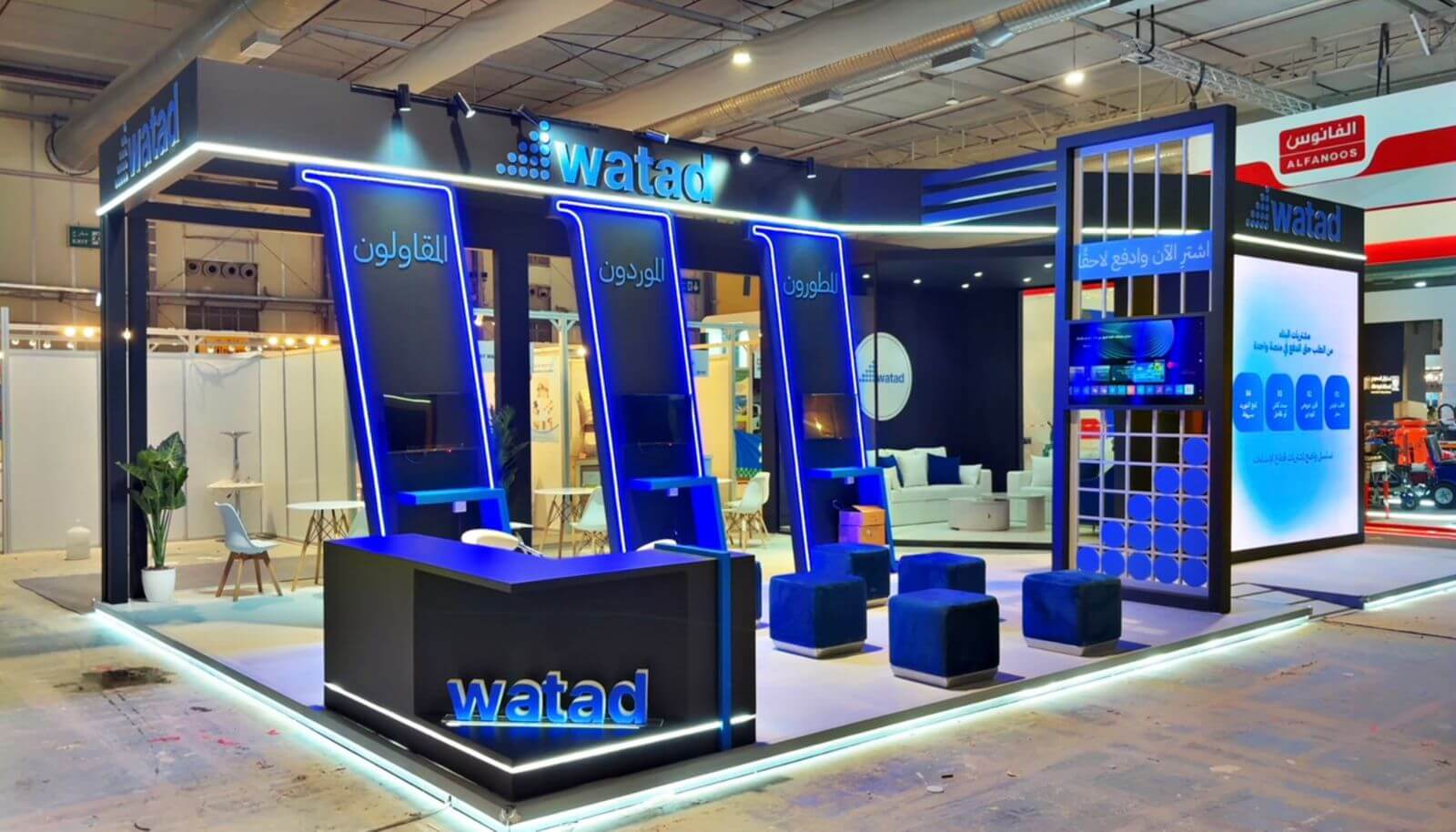
A practical example of SYNC’s exhibition production work is the Watad exhibition stand at BIG 5 Saudi Arabia.
SYNC’s published project describes the design, 3D visualization, fabrication, branding, installation, and on-site execution of Watad’s exhibition stand.
The work illustrates the coordination required to translate an approved stand design into an exhibition environment suitable for brand presentation and visitor engagement.
See the Watad BIG 5 exhibition stand project for the project scope and photographs.
This project demonstrates exhibition stand delivery capabilities. It is not presented as evidence that SYNC obtained the organizer’s license for BIG 5 Saudi Arabia.
Common Exhibition Licensing Mistakes to Avoid
Exhibition organizers can reduce preventable application difficulties by reviewing the following issues before submission:
- Choosing a license category that does not match the exhibition’s actual activities.
- Assuming exhibitor participation and exhibition organization have identical licensing obligations.
- Selecting a venue without checking the applicable requirements.
- Submitting inconsistent event dates, organizer information, or supporting documents.
- Treating an application submission as an issued license.
- Beginning restricted promotional activity before obtaining the necessary approval.
- Changing significant event details without checking the amendment procedure.
- Combining government licensing fees with unrelated production costs.
For exhibitions involving multiple participants, an early review of the intended format, organizer responsibilities, venue, and event timeline is particularly useful.
Frequently Asked Questions About SCEGA Exhibition Licenses
What is a SCEGA exhibition permit?
A SCEGA exhibition permit is an official authorization issued by the Saudi Conventions and Exhibitions General Authority for qualifying exhibition activities in Saudi Arabia. The applicable category depends on the exhibition format, organizer, and activities.
Do trade exhibitions require a SCEGA license?
Qualifying trade exhibitions fall under SCEGA licensing requirements. The organizer should confirm the appropriate service and meet its eligibility, documentation, and venue requirements.
What is the difference between a trade exhibition and a product showcase?
A trade exhibition generally focuses on business-to-business participation across companies, buyers, and suppliers. A product showcase is intended for qualifying presentations of a company’s products or services. The official category definitions determine which license applies.
How much does a trade exhibition license cost in Saudi Arabia?
SCEGA’s published government fee for a trade exhibition license is SAR 10,000. Additional venue, production, marketing, and professional support costs are separate.
Does a company need a license to exhibit at an existing trade show?
A participating exhibitor does not ordinarily apply for the organizer’s exhibition license. It must comply with the exhibition organizer’s conditions and any additional approvals applicable to its specific activities.
How long does the exhibition licensing process take?
The duration depends on the selected service, the completeness of the application, and the review requirements. Current published processing times should be checked through SCEGA, and approval dates should not be guaranteed.
Can a foreign company apply for an exhibition license?
Eligibility depends on the category of exhibition and the applicant’s legal and commercial status. Foreign organizers should check the relevant SCEGA requirements and whether an eligible organizing entity is necessary.
Is a SCEGA exhibition license the same as an exhibition stand permit?
No. An exhibition license concerns the authorization to organize the exhibition, while stand approval relates to an exhibitor’s installation and participation conditions within the venue.
Can an exhibition be advertised before approval?
Advertising and promotional activity may be restricted under the rules applying to the relevant exhibition category. Organizers should confirm the applicable requirements before launching campaigns or representing the event as licensed.
Can SYNC guarantee SCEGA exhibition license approval?
No. SYNC can provide application preparation, documentation, coordination, and event delivery support within the agreed scope. SCEGA is responsible for issuing or refusing official exhibition licenses.
Plan Your Exhibition in Saudi Arabia With SYNC
Securing the appropriate SCEGA exhibition license in Saudi Arabia starts with understanding the event category, organizer eligibility, documentation requirements, official fees, and venue conditions.
For a successful exhibition, regulatory preparation should also align with planning, production, exhibitors, and on-site execution.
Whether you are preparing a trade exhibition in Riyadh, a product showcase in Jeddah, or another qualifying exhibition elsewhere in Saudi Arabia, early coordination helps establish a clearer project plan.
Need support with your exhibition requirements?
Share your exhibition type, proposed location, event dates, and organizational details with SYNC. Our team can review your requirements and help identify the appropriate scope of licensing and event delivery support.
Request Exhibition Permit Support
Regulatory note: This article is provided for general planning and informational purposes. Official licensing decisions, requirements, and government fees are determined by SCEGA and may change. Verify current information through the authority before submitting an application or undertaking regulated activity.