What does full-service event management include?
Full-service event management brings the agreed planning, production and operating workstreams under one coordination structure. It can cover strategy, programme, venue, suppliers, budget, technical production, guest services, application support and reporting. The proposal must still say which deliverables are included, who approves them and where each responsibility ends.
Planning, production and on-site delivery
Planning sets the requirements and decisions. Production turns approved requirements into the event environment and technical setup. On-site management directs the live programme, people and responses. A company may provide all three or coordinate specialists; the contract should explain the actual arrangement.
For example, “manage registration” might mean preparing invitation data, configuring a system, printing badges and staffing check-in, or only supervising a client-owned platform. Those are different scopes. Ask for deliverables rather than accepting a broad service label.
Who does what: client, organizer, venue and suppliers?
Use a responsibility table before comparing proposals. An organizer can coordinate a task without being the party authorized to approve spending, sign a venue agreement or release guest information. Name both the person doing the work and the person making the decision.
| Workstream | Organizer’s agreed role | Client or specialist input |
|---|---|---|
| Objectives and programme | Develop options and a delivery plan | Client approves audience, messages and programme |
| Venue and suppliers | Check requirements and coordinate interfaces | Contracting party approves commitments and terms |
| Budget and changes | Track costs and identify scope effects | Authorized client approves additional expenditure |
| Production and rehearsal | Coordinate technical team and readiness | Specialists confirm specifications; client supplies approved content |
| Guests and registration | Run the contracted guest-service tasks | Client approves invitations, access rules and required data |
| Closeout | Reconcile agreed outputs and report findings | Client accepts deliverables and decides follow-up |
If a venue supplies in-house AV or catering, include it in the same coordination plan. Otherwise, a production team may be ready to rehearse while the room is still being reset. The important question is who resolves that clash, not how many suppliers appear in the proposal.
Which event services need explicit scope boundaries?
- Venue access: installation, rehearsal, event and dismantling windows, including who confirms access with the venue.
- Content: whether writing, translation, design, presentation formatting and revisions are included.
- Guest services: invitations, registration, accommodation and transport are separate tasks, even when coordinated together.
- Technical delivery: equipment, operators, show calling, streaming and backup arrangements need their own specifications.
- Reporting: agree the data, photographs, financial reconciliation and delivery date before the event.
Application support must also have a defined owner and scope. SYNC can support documented permit workstreams where agreed; the relevant authority makes the approval decision. Confirm the route for the actual programme rather than treating “permits included” as a guarantee.
Keep management fees, supplier commitments and changes visible in the event budget. A fixed coordination fee does not automatically fix every production or hospitality cost.
Full-service management or selected event support?
Choose the model around the work your internal team can reliably own. A single coordination lead is useful when venue, programme, production and guest operations depend heavily on one another. Selected support can work when your team already controls the master plan and needs a clearly bounded technical or operational package.
Ask three questions: Who maintains the integrated schedule? Who can approve a change? Who checks the handover between suppliers? If those answers remain unclear, dividing the work into smaller packages may increase coordination demands on your own team.
Use the corporate event planning checklist to identify missing workstreams. That checklist covers the planning sequence; this guide helps you define what to commission.
A documented SYNC example: DDC’s financial forum in Riyadh
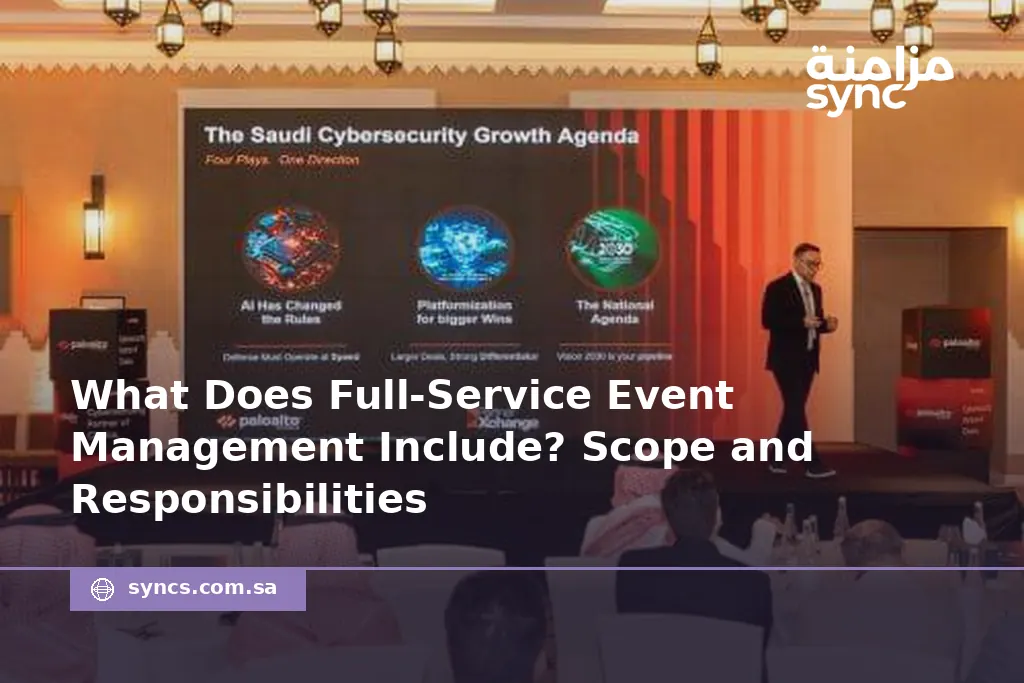
For DDC Financial Group’s Saudi Arabia Credit & Investment Forum 2026, SYNC’s published scope included event management, stage and audiovisual production, branding, delegate services, registration, on-site operations and documentation. The forum took place at Narcissus Hotel & Spa Riyadh on 7–8 October 2026.
The useful lesson is the connection between workstreams: stage delivery, attendee arrival and the live programme need compatible schedules. This is an example of a documented delivery scope, not evidence that every SYNC proposal includes the same services.
What should you receive before approving an event proposal?
- A deliverables list with quantities or a clear basis for quantities.
- A responsibility matrix covering client-supplied and separately contracted work.
- A schedule showing approval deadlines, venue access, rehearsal and dismantling.
- A cost basis that identifies assumptions, optional items and change approval.
- A named coordination lead, escalation route and closeout requirements.
Test the proposal against a realistic change: a speaker joins remotely, the guest count rises or the venue shortens installation access. Ask who assesses the impact, who decides and how the revised instruction reaches the team. This reveals whether the coordination structure can handle the event you are buying.
SYNC’s event management services in Saudi Arabia can be scoped around these workstreams. Start with the event type, city, intended audience, programme and existing commitments.
Frequently asked questions
Can we appoint an organizer after booking the venue?
Yes, subject to availability and scope. Share the signed venue agreement, access restrictions, committed suppliers and approved programme. The organizer should identify which decisions can still change and which commitments must be worked around.
Does a venue coordinator replace an event manager?
Not necessarily. Confirm whether the venue coordinator covers only the venue’s services or also owns external suppliers, the programme, guest operations and show cues. Avoid assigning the same task to both teams without naming a lead.
Can we keep our preferred suppliers?
You can request this. Define whether the organizer supervises, coordinates or contracts each supplier, and agree the information and readiness checks needed. Do not assume a coordination role changes the supplier’s contract.
Does full-service management mean the company owns all equipment?
No. Full-service describes the agreed delivery scope, not equipment ownership. Ask who supplies, installs, tests and operates each technical element, and who coordinates replacements if a critical item fails.
How should additional work be approved during the event?
Name an authorized approver and an escalation route in advance. Record the instruction, cost and schedule effect through the agreed process. Safety-critical decisions should follow the site’s approved procedures and competent personnel, not wait for an ordinary purchasing discussion.